Peace Is a Practice at the Crossroads
A reflection on choice, the power of walking, and ways we can live well and in peace

The Huong Dao Vipassana Bhavana Center monks’ Walk for Peace culminated in their arrival in Washington, D.C. on a chilly Tuesday Feb. 10, and for me, this along with Dr. Opal Lee’s walk from Fort Worth to Washington, D.C. to secure Juneteenth’s recognition as a federal holiday, stands among the most inspiring stories of the 21st century in the United States.
The monks’ community has been part of Fort Worth for more than 25 years. Guided by Venerable Bhikkhu Pannakara, the monks and Aloka the rescue dog walked along a roughly 2,300-mile path to D.C. Their journey is rooted in an ancient Buddhist monastic practice that emphasizes mindfulness, compassion, and endurance. Throughout the walk, the monks moved with intention each day, frequently sleeping outdoors and trusting the generosity of local communities.
On Nov. 19, a truck crash seriously injured several of the monks, one of whom required the amputation of his leg. After a pause to tend to those harmed, the remaining monks resumed the walk, at times barefoot and over rough roads.
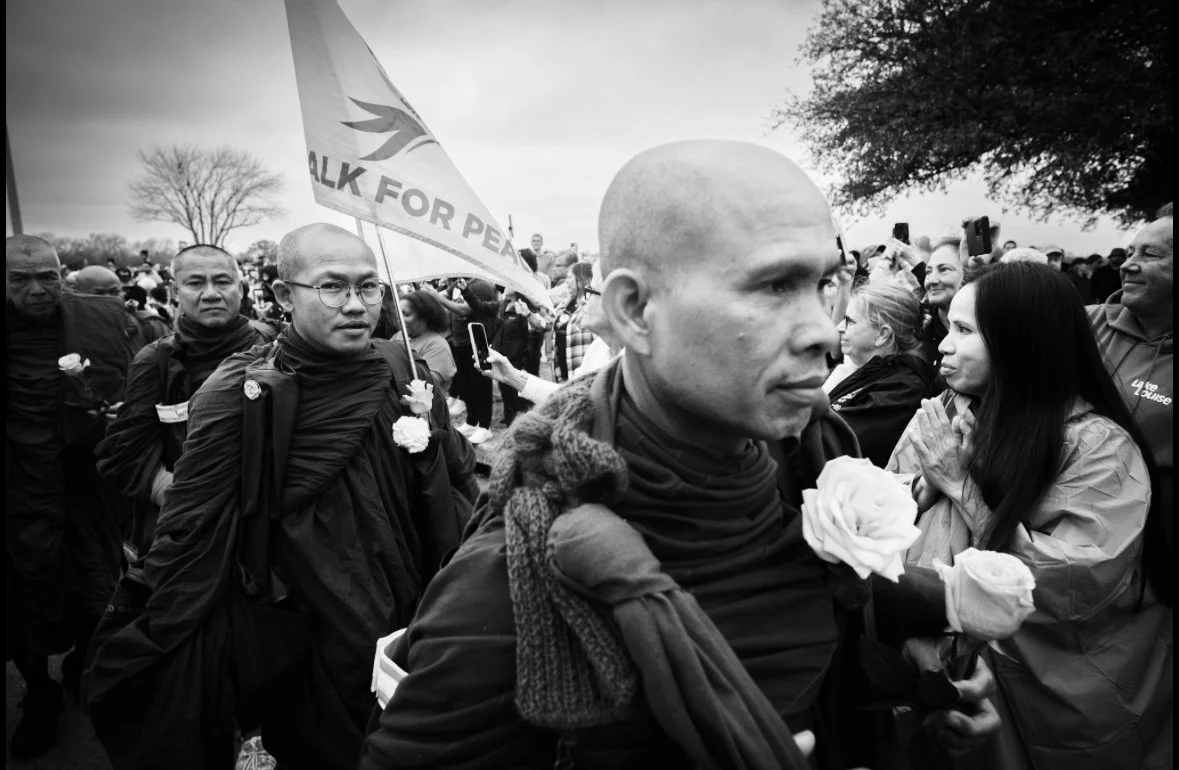
Photo by Silvio Amir
Bhikkhu Pannakara's Fort Worth Homecoming Talk, Feb. 14
They carry no protest signs and stage no political demonstrations. Instead, their journey is a pilgrimage offered to inspire each of us to do what we can to support the well-being of all. The message: peace begins within each person and then radiates outward, like rippling water. Slowing down with the breath, each step as intentional as the next.
Walking with nature is one way to bring joy, care and peace into our lives. The monks are gently inspiring us all to do the same. The practice involves coming home to the present moment, to the body and breath, to life as it is, with all its ups and downs. This presence combined with kindness helps attune to living in a supportive and caring relation with all living beings and Earth.
The Walk for Peace has taken the monks through towns and landscapes shaped by long histories, including Montgomery, Alabama, a city that remains very much alive in U.S. history, highlighted by the civil rights movement along with the leadership of Rosa Parks and Dr. Martin Luther King Jr.
In essays such as “The Power of Nonviolence,” “An Experiment in Love,” and “A Christmas Sermon on Peace,” Dr. King reflects on the ancient Greek word agape. His sense of agape emerges from the spiritual tradition in which he was raised, yet in his characteristic way, King’s message speaks across all cultures and spiritual traditions.
The word agapein reaches back thousands of years, at least to Homer, and means to “show affection for” or “cherish.”
To cherish: to protect and care for lovingly.
In “A Christmas Sermon on Peace,” King writes that agape is “understanding, creative, redemptive goodwill toward all men. Agape is an overflowing love, which seeks nothing in return.”
King’s vision of the Beloved Community called for a society rooted in nonviolence, mutual care, and the recognition of our shared humanity. Less widely known yet certainly relevant here was his friendship with the Vietnamese Buddhist monk and teacher Thích Nhất Hạnh. During the 1960s, the two men found connection in their belief that inner growth and social progress are reciprocally related. Thích Nhất Hạnh calls this relation “interbeing,” namely, that we are fundamentally interconnected across all differences.
King personally nominated Thích Nhất Hạnh for the Nobel Peace Prize in 1967, recognizing him as an “Apostle of peace and nonviolence.”
Dr. Lee set out in 2016 at 89 to walk from Fort Worth to Washington, D.C. to catalyze national support for designating June 19 as a federal holiday.
June 19, 1865 marks the time in Texas when slaves were finally told they were free, two years after the Emancipation Proclamation. With peace, dedication, and a “stern love,” as Dr. King says, she took her walk in peace year by year, as she could.
Congress and President Biden brought the Juneteenth National Independence Day Act into law, recognizing June 19 as a federal holiday in 2021. Dr. Lee was awarded a Presidential Medal of Freedom in 2024.
Like the monks, she understands that peace is inseparable from care for community and the living land. Dr. Lee, a longtime K–12 educator, continues to dedicate herself to ensuring children and families in Fort Worth have access to nutritious food to eat. Opal’s Farm here in Fort Worth produces tons of fresh vegetables each year, much of it donated to those in need.
Those two different walks for peace rooted in Fort Worth tell us something important about who we are and who we are becoming. Beyond the crush of traffic, Fort Worth is a city of walkers. This city has quietly given rise to a community of folks who understand that enduring change requires patience, presence, and a willingness to appreciate our shared humanity – we are all in this together.
Fort Worth has been my home since 1998. Naturally, there has been a lot of change, with the population doubling and the city taking on a greater national presence.
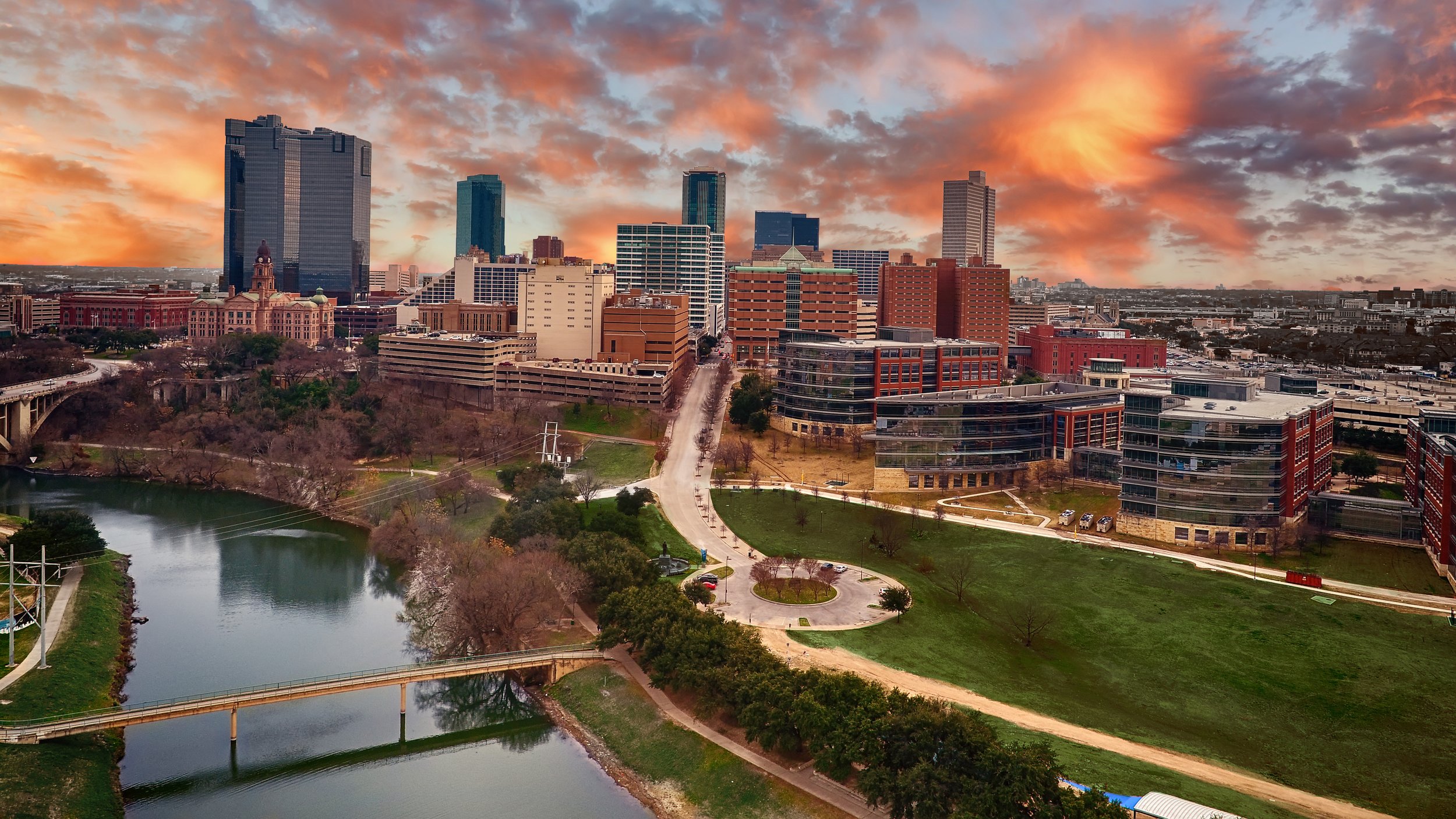
Sunrise in Fort Worth
The city is standing at a momentous crossroads – in fact, Fort Worth is something of a microcosm of the U.S. We can collectively continue down this path of rising energy and water use, accelerated development, and increased consumption, or we can collectively choose a path that elevates the well-being of all people and actively promotes stewardship of the land and ecosystems that sustain healthy people, healthy communities, and a healthy planet.
We are the future ancestors, our world the future ancient, and we are responsible for the world our children and their children will carry forward. By caring for ourselves and the living lands now, we help everyone get along in the world and contribute meaningfully to making our own and our children’s future brighter.
Peace is a practice. Flourishing begins within and with nature. Our choices are the substance of who we become as a people. Onward in care for living lands, oceans, and skies, with gratitude for these amazing people and all the peaceful walkers in Fort Worth.
As Bhikkhu Pannakara spoke to an audience in Georgia, “We have to work within ourselves, to bring peace for ourselves, and then we can spread it out.”
Dr. Blake Hestir is President and Co-founder of the Mind Body Ecology Institute and Professor of Philosophy and Associate Director of CALM Studies at Texas Christian University. He is also a member of the Flourishing Academic Network.
His work explores the relationship between the nature of self, ecological interdependence, and people’s intrinsic capacity for resilience. Through research, teaching, and eco experiential programs, he investigates how these insights can support well-being, strengthen communities, and foster personal and planetary flourishing.